

Investing in the future: The Energy Challenge
How can a wind farm become an attractive investment? Students at the Berlin School of Economics and Law explored this question in two energy modules, concluding with a poster presentation.
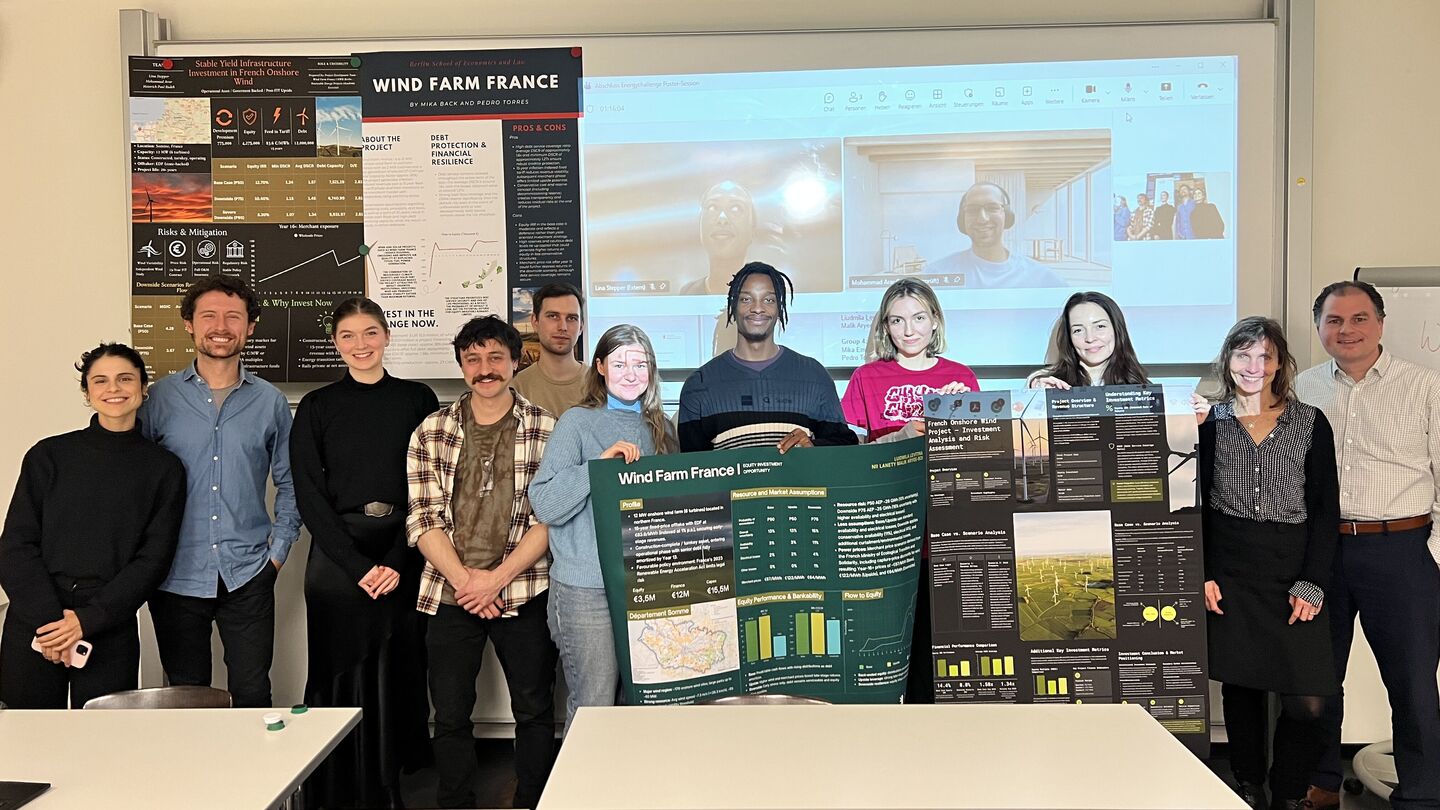
The two energy modules, ‘Introduction to Renewable Energy Projects: Development, Finance and Legal Aspects’ and ‘Financial Modelling and Power Purchase Agreements in Renewable Energy Projects – Masterclass,’ were developed as part of the Studium Generale programme with prize money from ProjectTogether and implemented in collaboration with project partners RENAC AG and Novisio.
They are embedded in the ‘10,000 Days’ initiative, an implementation alliance of partners from civil society, business, government and science initiated by the Federal Ministry of Education and Research and ProjectTogether. The aim of the alliance is to broadly mobilise, train and strengthen skilled workers for the decarbonisation of the economy and society.
Over the past few months, participants have immersed themselves in the world of renewable energies. The focus was not only on technology, but above all on the question: How do you plan, finance and secure a wind or solar project in such a way that it is economically viable?
The students learned what steps a project goes through from the initial idea to commissioning, what role banks and investors play, and why contracts and smart financing structures are crucial for success. The aim was not only to understand renewable energy projects, but also to be able to evaluate them from the perspective of investors.
The Energy Challenge: A wind farm seeks investors
The second module took a particularly practical approach: in a realistic ‘Energy Challenge’, the students took on the role of senior analysts for a project developer. Their task was to prepare a completed 12 MW wind farm in France in such a way as to convince an institutional investor to provide equity capital.
To this end, the teams developed financial models, analysed opportunities and risks, and examined how changing electricity prices or rising costs would affect profitability. In the end, one key question remained: Is this project attractive enough to justify millions in investment?
A big stage for big ideas
The highlight was the final poster presentation in World Café format. The groups presented their analyses, market considerations and investment recommendations on large-format A0 posters. In the subsequent discussions, the teams defended their assessments and answered critical questions from renac lecturers.
More than theory
The modules impressively demonstrated how closely economic thinking, legal frameworks and energy policy developments are interlinked. Above all, however, they made it clear that the energy transition is not only a technical challenge, but also a financial and strategic one. With their successful final presentation, the students proved that they are capable of dealing with complex